
Have you ever looked at a measurement and wondered what it actually looks like in real life? Whether you’re measuring an object, shopping online, working on a DIY project, or converting measurements for school, understanding 5 inches can make things much easier.
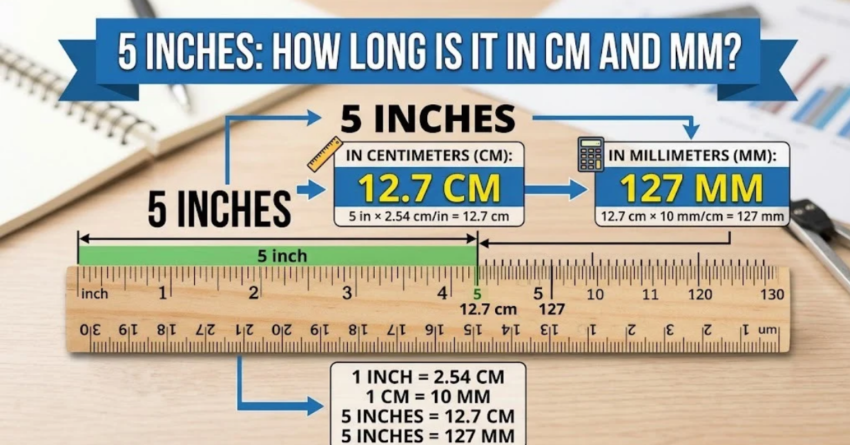
Five inches is a relatively short length, but it can be useful in many everyday situations. It equals 12.7 centimeters (cm) or 127 millimeters (mm). Once you know these conversions and compare the measurement with familiar objects, it’s much easier to picture its actual size.
In this guide, we’ll explain how long 5 inches is, how to convert it into different units, what it looks like in everyday life, and how it relates to other common measurements.
How Long Is 5 Inches?
Five inches is exactly five times the length of one inch. In the imperial measurement system, inches are commonly used in the United States to measure objects, screen sizes, furniture dimensions, and many other things.
Here are the basic conversions:
| Measurement unit | Equivalent to 5 inches |
| Inches | 5 inches |
| Centimeters | 12.7 cm |
| Millimeters | 127 mm |
| Feet | 0.4167 ft |
| Meters | 0.127 m |
The easiest conversion to remember is that 5 inches equals 12.7 cm. If you’re using a metric ruler, look for the 12.7 cm mark to measure the same length.
5 Inches to CM: What Is the Conversion?
If you’re searching for 5 inches to cm or wondering how much 5 inches is in centimeters, the answer is 12.7 cm.
One inch is defined as exactly 2.54 centimeters. Therefore, converting inches into centimeters involves multiplying the number of inches by 2.54.
Formula for converting inches to centimeters
Centimeters = Inches × 2.54
For five inches:
5 × 2.54 = 12.7 cm
So, 5 inches in cm is 12.7 centimeters.
This conversion is helpful when reading product dimensions, measuring household items, following craft instructions, or comparing measurements from countries that use different systems.
Inches to centimeters conversion table
| Inches | Centimeters |
| 1 inch | 2.54 cm |
| 2 inches | 5.08 cm |
| 3 inches | 7.62 cm |
| 4 inches | 10.16 cm |
| 5 inches | 12.7 cm |
| 6 inches | 15.24 cm |
| 10 inches | 25.4 cm |
5 Inches to MM: How Many Millimeters?
Five inches equals 127 millimeters. Millimeters are particularly useful for small objects, hardware, product specifications, and precise measurements.
Since one inch equals 25.4 millimeters, you can convert inches to millimeters by multiplying the measurement by 25.4.
Formula for inches to millimeters
Millimeters = Inches × 25.4
For five inches:
5 × 25.4 = 127 mm
Therefore, 5 inches to mm is 127 mm.
What is .5 inches to mm?
A half inch is much shorter than five inches. To convert 0.5 inches into millimeters:
0.5 × 25.4 = 12.7 mm
So, .5 inches equals 12.7 mm.
Remember the difference: 5 inches is 127 mm, while 0.5 inches is only 12.7 mm. The decimal point changes the measurement significantly.
What Does 5 Inches Look Like?
Understanding a number is one thing, but visualizing its length is another. If you don’t have a ruler nearby, familiar objects can help you estimate what five inches looks like.
Here are a few useful comparisons.
1. A little longer than a standard smartphone’s width
Many smartphones are around 2.5 to 3.5 inches wide, depending on the model. Five inches is generally longer than a phone’s width, making it a useful rough comparison.
Keep in mind that phone dimensions vary, so this is only an estimate.
2. About the length of a small pencil or stationery item
Some compact stationery items, miniature pencils, and small tools measure close to five inches. Comparing your measurement with an object of a known size can help you visualize the length.
However, a regular full-size pencil is usually longer than five inches.
3. A little shorter than half a standard sheet of paper’s width
A standard US Letter sheet is 8.5 inches wide. Five inches is shorter than its width by 3.5 inches, so comparing the two gives you a simple reference.
4. About the length of a large index card’s shorter side plus a little extra
Index cards come in different sizes, but a common 5-by-8-inch card has one side measuring exactly five inches. If you have one available, it can provide a convenient visual reference.
The most reliable way to check the length is to use a ruler or measuring tape rather than relying on object comparisons alone.
Everyday Objects That Measure Around 5 Inches
Five inches can appear in a variety of everyday items, although exact dimensions depend on the product.
Examples include:
- Small kitchen tools: Certain compact utensils and accessories may measure around five inches.
- Craft supplies: Small rulers, decorative pieces, and craft components may have a five-inch dimension.
- Personal accessories: Some compact cases, wallets, and pouches are close to five inches in one dimension.
- Small electronic accessories: Certain adapters, holders, or compact devices may be approximately five inches long.
- Stationery: Some index cards and miniature writing tools use dimensions close to five inches.
These examples are intended to help you picture the measurement, not to serve as exact standards. Always check the manufacturer’s dimensions when accuracy matters.
How to Measure 5 Inches Without a Ruler
If you need to estimate five inches but don’t have a measuring tool, there are a few practical alternatives.
- Use a smartphone measurement app. Some phones include measuring tools that use the camera to estimate dimensions. Their accuracy depends on the device and conditions.
- Compare it with a known object. An index card or another item with verified dimensions can help you estimate the length.
- Use a printable ruler. Print a ruler at its intended scale and check it against a physical reference before using it.
- Measure with a tape measure. If you need an accurate result for cutting, installation, or fitting, a physical measuring tool is the better choice.
For precise work, don’t rely solely on visual estimates. Even a small measurement error can affect how well an item fits.
How Tall Is 5 Feet 5 Inches in CM?
It’s important to distinguish 5 inches from 5 feet 5 inches. Five inches measures a short length, while 5 feet 5 inches is a person’s height.
To convert 5 feet 5 inches into centimeters, first convert the feet into inches and then convert the total into centimeters.
-
1 foot = 12 inches
-
5 feet = 5 × 12 = 60 inches
-
Add the remaining 5 inches: 60 + 5 = 65 inches
-
Convert to centimeters: 65 × 2.54 = 165.1 cm
Therefore, 5 feet 5 inches equals 165.1 cm, or approximately 1.65 meters.
5 foot 5 inches in inches
Five feet five inches equals 65 inches in total.
The calculation is straightforward:
5 × 12 + 5 = 65 inches
Whether you write 5 feet 5 inches, 5 ft 5 inches, or 5’5″, the measurement represents the same height.
How to write 5 feet 5 inches correctly
There are several commonly accepted ways to express this measurement:
-
5 feet 5 inches
-
5 ft 5 in
-
5’5″
The apostrophe represents feet, while the quotation mark represents inches. In technical documents, using clear labels such as “5 ft 5 in” can help prevent confusion.
Is 5 Inches Small?
Whether five inches is considered small depends entirely on what you’re measuring. A five-inch object might be large for a tiny accessory, small for a household appliance, or perfectly suitable for a particular design or construction project.
For example:
-
For a small object: Five inches may be a convenient, practical size.
-
For a screen: A five-inch diagonal measurement describes a relatively compact display compared with many modern phones and tablets.
-
For furniture: Five inches might describe the thickness of a cushion, the height of a component, or a small gap.
-
For personal height: Five inches alone isn’t a meaningful height measurement without additional context.
Instead of asking whether five inches is universally small or large, consider the item’s intended purpose, the space available, and the dimensions you actually need.
Is 5 inches enough?
Five inches can be enough for many practical purposes, including small storage compartments, craft projects, accessories, and compact design features. Whether it is sufficient depends on the object’s function and the requirements of the task.
For example, a five-inch shelf depth may work for certain decorative objects but may be inadequate for larger items. Similarly, a five-inch gap may be suitable in one layout and inconvenient in another.
The best approach is to compare the measurement with the dimensions of the item you intend to use.
What Does 5 Inches of Snow Look Like?
Five inches of snow equals 12.7 centimeters of snow depth. This measurement describes how deep the snow is on a relatively level surface, not how much water it contains.


Five inches of snowfall can make sidewalks, lawns, driveways, and parked vehicles noticeably snow-covered. The actual effect depends on the type of snow, temperature, wind, and surface conditions.
Is 5 inches of snow a lot?
Five inches of snow is a meaningful accumulation, but its impact varies by location and local preparedness.
-
Walking: Paths may become slippery or difficult to navigate.
-
Driving: Roads may become hazardous, especially if snow is compacted or icy.
-
Daily activities: Shoveling may be necessary to clear entrances and walkways.
-
Travel: Delays are possible depending on road treatment, visibility, and local conditions.
Wet, heavy snow can be more difficult to shovel than light, powdery snow at the same depth. Always follow local weather and travel advisories when snowfall affects your area.
Five Inches vs. Other Common Measurements
Comparing five inches with nearby measurements makes it easier to understand the difference between short lengths.
| Measurement | Centimeters | Millimeters |
| 0.5 inches | 1.27 cm | 12.7 mm |
| 1 inch | 2.54 cm | 25.4 mm |
| 2 inches | 5.08 cm | 50.8 mm |
| 3 inches | 7.62 cm | 76.2 mm |
| 4 inches | 10.16 cm | 101.6 mm |
| 5 inches | 12.7 cm | 127 mm |
| 6 inches | 15.24 cm | 152.4 mm |
| 10 inches | 25.4 cm | 254 mm |
Notice that five inches is ten times the length of half an inch. This is why checking decimal points is particularly important when working with measurements.
Understanding the Meaning of 5 Inches in Different Contexts
The same measurement can mean different things depending on the situation.
5 inches in product dimensions
Online shopping listings may use inches to describe the length, width, height, or diagonal of an item. Check which dimension is being reported before comparing products.
For example, a device described as five inches long may not be five inches wide or tall.
5 inches in interior design and DIY projects
In home improvement and interior design, five inches may describe a furniture component, a wall feature, a gap, or the depth of a decorative element.
When planning a layout, it is helpful to convert the measurement into centimeters if your drawings or specifications use metric units. Five inches is 12.7 cm, which makes it easier to incorporate into a metric-based plan.
For installation, joinery, or construction, always measure the actual site and follow the project’s specifications rather than relying on approximate comparisons.
5 inches in personal measurements
Some searches for five inches relate to intimate body measurements. In this context, there is no universal answer to whether five inches is “small” or “enough.” The answer depends on the specific measurement, individual variation, and what the person is asking about.
For penis length specifically, five inches is within the range reported in clinical research on erect length. A systematic review published in BJU International in 2015 estimated an average erect penis length of approximately 13.12 cm (5.17 inches) across the studies it analyzed. Individual measurements naturally vary, and an average is not a standard that everyone must meet.
For personal health questions, comfort, function, and individual circumstances are more useful considerations than comparisons alone.
Quick Conversion Tips for Inches
If you frequently work with inches, a few simple rules make conversions much easier.
-
Inches to centimeters: Multiply by 2.54.
-
Inches to millimeters: Multiply by 25.4.
-
Centimeters to inches: Divide by 2.54.
-
Millimeters to inches: Divide by 25.4.
-
Feet and inches to total inches: Multiply the feet by 12, then add the remaining inches.
For example, if you want to convert 8 inches to centimeters, multiply 8 by 2.54 to get 20.32 cm.
For five inches, the results are especially easy to remember: 12.7 cm and 127 mm.
Frequently Asked Questions About 5 Inches
1. What is 5 inches in cm?
Five inches equals 12.7 centimeters. To calculate it, multiply 5 by 2.54, since one inch is exactly 2.54 cm.
2. How many millimeters are in 5 inches?
There are 127 millimeters in 5 inches. Multiply the number of inches by 25.4 to convert the measurement into millimeters.
3. How long is 5 inches?
Five inches is 12.7 cm long. You can visualize it using an object with a known five-inch dimension, such as the shorter side of a 5-by-8-inch index card.
4. What does 5 inches look like?
Five inches looks like a short hand-held length, approximately 12.7 cm. A ruler is the easiest way to see the exact distance and compare it with familiar objects.
5. How much is 5 inches in feet?
Five inches equals approximately 0.4167 feet. This is calculated by dividing 5 by 12 because one foot contains 12 inches.
6. What is .5 inches to mm?
Half an inch, written as 0.5 inches, equals 12.7 mm. This is different from five inches, which equals 127 mm.
7. How many inches are in 5 feet 5 inches?
Five feet five inches equals 65 inches. Multiply 5 feet by 12 to get 60 inches, then add the remaining 5 inches.
8. How tall is 5 feet 5 inches in cm?
A height of 5 feet 5 inches equals 165.1 cm, or approximately 1.65 meters.
9. Is 5 inches small?
It depends on what is being measured. Five inches may be a suitable size for a small accessory or component but too short for another purpose. Context is essential.
10. Is 5 inches enough?
Five inches may be sufficient for many objects, design features, and practical applications. Whether it is enough depends on the intended use, required clearance, and relevant specifications.
11. What does 5 inches of snow mean?
It means the snow has accumulated to a depth of five inches, or 12.7 cm. Its effect on roads, sidewalks, and travel depends on weather conditions and local preparation.
12. How do you write 5 feet 5 inches?
Common formats include 5 feet 5 inches, 5 ft 5 in, and 5’5″. The last format uses an apostrophe for feet and a quotation mark for inches.
Conclusion
Five inches is a straightforward measurement once you know its metric equivalents. It equals 12.7 centimeters, 127 millimeters, and approximately 0.4167 feet. These conversions are useful for shopping, DIY projects, interior design, personal measurements, and everyday comparisons.
If you’re trying to picture how long 5 inches is, use a ruler or compare it with an object whose dimensions you know. For height conversions, remember that 5 feet 5 inches is a different measurement altogether: it equals 65 inches or 165.1 cm.
Understanding these basic conversions can save time and prevent mistakes when switching between imperial and metric measurements. For more practical guidance, explore related inch-to-centimeter conversion guides and measurement references.